
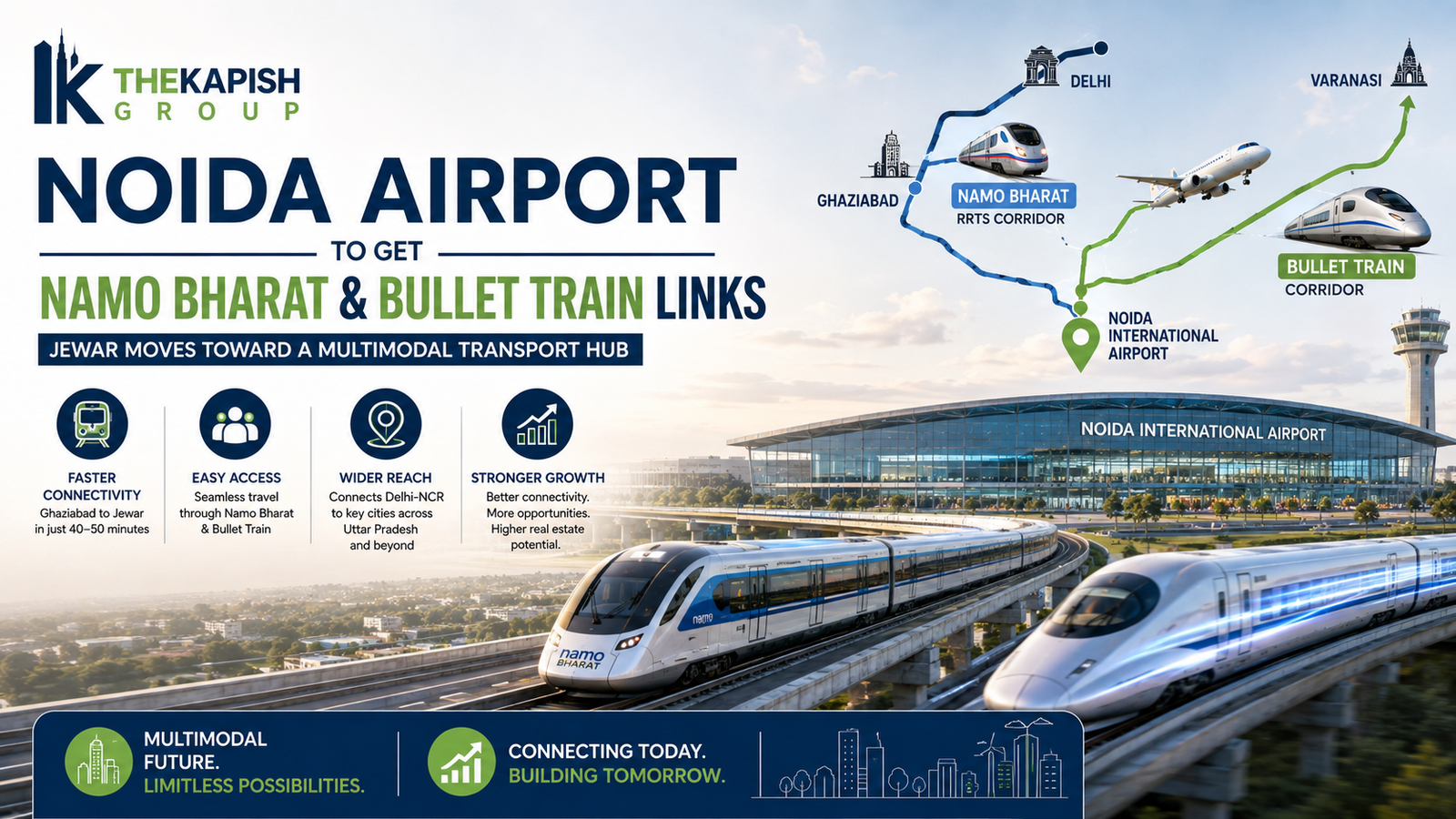
Noida International Airport is gradually becoming more than an aviation project.
In a major connectivity development reported on 15 July 2026, plans are progressing to connect the airport with both the Namo Bharat Regional Rapid Transit System (RRTS) and the proposed Delhi–Varanasi High-Speed Rail Corridor.
If implemented as planned, these projects could significantly improve access to Jewar from Delhi-NCR and several major cities across Uttar Pradesh.
For investors and businesses tracking the Yamuna Expressway region, the larger story is clear: Jewar is steadily being positioned as a multimodal transport and economic hub.
Ghaziabad–Jewar Namo Bharat Corridor
One of the major proposals is the Ghaziabad–Jewar Namo Bharat corridor, designed to connect Ghaziabad, Greater Noida and Noida International Airport.
The proposed route is expected to pass through major locations including:
- Greater Noida West
- Surajpur
- Pari Chowk
- Ecotech VI
- Dankaur
- YEIDA Sector 18
- YEIDA Sector 21
- Noida International Airport
According to reports, the proposed rapid rail could reduce travel time between Ghaziabad and the airport to approximately 40–50 minutes.
The airport station is also expected to integrate with other transport networks, potentially allowing passengers to shift between regional rail, metro and air travel.
Bullet Train Connectivity Could Expand Jewar’s Reach
The second major proposal is the Delhi–Varanasi High-Speed Rail Corridor.
The planned route is expected to include a station at Noida International Airport, helping connect Jewar with Delhi as well as major cities across Uttar Pradesh and eastern India.
Proposed destinations along the wider corridor include:
Mathura, Lucknow, Prayagraj, Ayodhya, Varanasi and other eastern cities.
This could significantly enlarge the airport’s passenger catchment area.
Instead of serving primarily Delhi-NCR, Noida International Airport could eventually become accessible to travellers across a much larger part of northern and eastern India.
Why Multimodal Connectivity Matters
Large airports generally become more economically important when they are supported by multiple transport options.
Jewar is increasingly being connected through:
Expressways
Regional buses
Proposed Namo Bharat
Metro connectivity
High-speed rail
Airport cargo infrastructure
This creates a network where passengers, employees, businesses and goods can move efficiently through the region.
For the surrounding economy, that can be just as important as the airport itself.
What Could This Mean for Real Estate?
Rail connectivity can influence real-estate growth differently from highways.
Stations often become concentrated points of passenger movement, employment and commercial activity.
If the proposed rail corridors move into execution, areas around key transport nodes could gradually see stronger demand for:
- Residential housing
- Rental accommodation
- Commercial offices
- Hotels and hospitality
- Retail
- Business centres
- Transport services
- Mixed-use development
However, investors should not assume that every plot near a proposed alignment will automatically benefit.
The final impact will depend on approved station locations, land use, access roads, sector planning and project execution timelines.
Sector 21 Could Become Especially Important
One location worth watching is YEIDA Sector 21.
The proposed Namo Bharat corridor includes a YEIDA Central station around Sector 21, while the same broader area is also associated with major developments such as the International Film City and proposed AVGC-XR ecosystem.
This creates the possibility of multiple economic and transport activities converging in the same wider zone.
Such convergence is often important for long-term urban development because infrastructure is supported by actual employment and visitor-generating destinations.
Jewar Is Moving Beyond Road Connectivity
Until recently, most connectivity discussions around the Yamuna Expressway focused on highways and expressways.
That is now changing.
The addition of rapid rail and high-speed rail proposals signals a shift toward integrated public transport infrastructure.
The emerging model can be understood as:
Airport → Expressways → Metro → Namo Bharat → High-Speed Rail
If these projects progress, Noida International Airport could become one of the most connected transport nodes in the NCR region.
What Investors Should Watch Next
Both rail projects remain dependent on detailed approvals, financing, final alignments and execution.
Investors should therefore monitor:
- Final station locations
- Approved alignment
- DPR progress
- Land acquisition
- Construction timelines
- Integration with YEIDA sectors
- Planned commercial and residential land use
The strongest investment locations may eventually be those where transport connectivity, employment centres and approved urban planning overlap.
That is a much stronger basis for long-term investment than simply buying land near a proposed route.
How The Kapish Group Helps
The Kapish Group helps investors evaluate opportunities across YEIDA and the Noida International Airport region through master-plan analysis, land verification, authority checks and infrastructure-led location assessment. We help clients separate genuine long-term opportunities from speculative claims before making an investment decision.